Budget Topline Issue #2, Urgent Displacing the Foundational - Indian Water Rights Settlements
For our next major budget topline issue, we’re focusing on Indian water rights settlements as an example of responding to the urgent resulting in displacement of foundational priorities. The Federal government is on the hook to provide more than $312 million by 2029 to meet the enforceability requirements of the Hualapai Tribe Water Rights Settlement Act (PL 117-349) and is increasingly facing a growing balloon payment. The Debt Ceiling deal with lower budget caps went into effect in FY 2024, constraining resources that could be available for the settlement. No significant funding has been appropriated since the settlement was enacted in 2023. As a result, there are now only three fiscal years (2027-2029) for the Federal government to cover the amount necessary to meet settlement enforceability requirements. The fiscal outlook does not look great in the future years, so this is not a challenge that will get easier with time.
Why is this such a challenge and what can be done?
Providing additional funding for Indian water rights settlements is challenging when there are other major costs to be funded, as I’ve mentioned with Contract Support Costs and 105(l) leases, combined with a constrained budget. For context, $312 million is 7.8% of the Bureau of Indian Affairs budget. The cost will go up once final indexing (inflation payment) is calculated. The chart below shows that gradually building in water settlement costs can be more manageable, especially within the Interior and Environment appropriations bill, which is less likely to receive surges in funding than other appropriations bills. Given that no noticeable amounts have been appropriated, current options illustrate that a lot of money will be needed over the next three fiscal years.
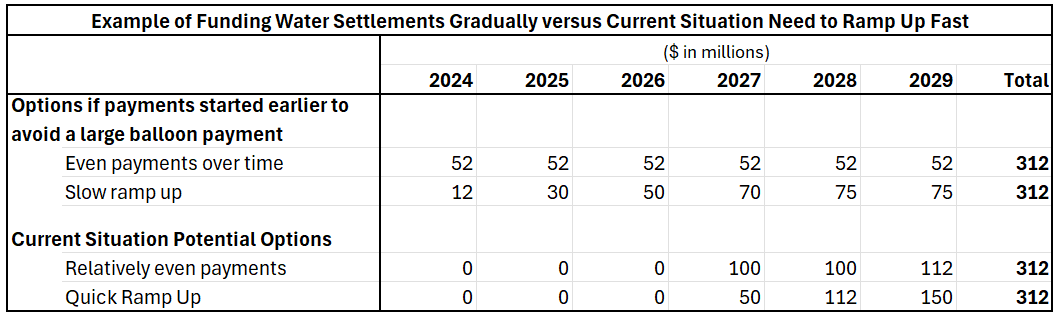
Chart shows funding scenarios for an Indian water rights settlement with an enforceability date in in FY 2029.
Why are Indian water rights settlements important? Indian water rights settlements are critical for providing Tribal Nations with reliable, clean water, fulfilling the federal government's trust responsibility, enabling economic development, and resolving decades-old disputes with surrounding communities by securing quantified water rights and funding for infrastructure, benefiting water users by bringing certainty to resource management.
The lack of funding for the Hualapai settlement to date can also have a dampening effect on settlements pending authorization in Congress. The Federal government has not failed to enforce its actions for a water settlement in recent history. If this happens, technically the settlement falls apart, and the parties (Tribe, States, Federal government) must start over. Congress can also amend the current settlement to buy more time to gain the necessary funding. For a deeper background and a list of enacted settlements and settlements pending authorization, check out this Congressional Research Service report on Indian water rights settlements (July, 2025).
Who funds Indian Water Rights Settlements?
Settlement requirements are developed through negotiations among the Tribe, relevant State government, and Federal government, and then codified in Authorizing legislation. Funding requirements are generally paid for through the budgets of the Bureau of Reclamation and the Bureau of Indian Affairs. To date, and in general, Reclamation pays for project-based settlements, where Reclamation is building the project, and BIA pays for trust fund-based settlements, where funding is placed in a Trust Fund and earns interest until the Tribe builds out water projects or related authorized activities. As self-determination has increased, the recent trend has been for water rights settlements to be more trust fund-based, providing funding to the Tribes for project implementation.
Even though both bureaus are in the Department of the Interior, Reclamation is funded through the Energy and Water Appropriations Subcommittee, and BIA is funded through the Interior and Environment Appropriations Subcommittee. Arguably, the Energy and Water appropriations bill is better suited to absorb the new, high costs of enacted water rights settlements. Much of the Energy and Water bill is based on large projects that go up and down annually, leaving room for decision-making trade-offs among projects each year. By comparison, the Interior and Environment bill largely supports operational costs (salaries and benefits, predictable annual facility maintenance), which require more stable funding trajectories.
The FY 2026 Joint Explanatory Statement for the Energy and Water bill noted Bureau of Reclamation should spend at least $20 million in discretionary funding on water settlements. This funding is complemented by $120 million in mandatory funding that Reclamation receives each year out of its Indian Water Rights Settlement Fund. Given tight funding this year, it will be important to see the operating plan for how Reclamation will fund its settlements. This fund is authorized through FY 2029. BIA does not have a mandatory funding source for Indian water rights settlements.
Hail Mary Option? This is not impossible, but it is not prudent to wait. The $2.5 billion Indian Water Rights Settlement Completion Fund, included in the Bipartisan Infrastructure Law (PL 117-58), was one of those once-in-a-generation opportunities to address significant water rights settlement costs, such as the $1.9 billion Montana Water Rights Protection Act. It could be that there will be an alignment of stars, and a solution will be found for another source of mandatory funding, but there is no guarantee. Considerations for reauthorization for the Reclamation’s Water Right Settlement Fund, which expires at the end of FY 2029, could include providing the authority for funding at the level of the Interior Secretary, so funding could be used by either or both BIA or Reclamation for water rights settlements. However, that timeline does not work well for the Hualapai settlement unless Congress acts early. Another option would be to fund water settlements through the Energy and Water Appropriations Subcommittee, as discussed above.
Most likely, it may be left to the Interior and Environment subcommittee, which, I noted in previous posts, is also facing rising costs from other legally required payments, 105(l) Tribal leases, and Contract Support Costs - as well as operational needs. Whether through a discretionary funding increase or a new mandatory funding source, the Administration and Congress need a solution to these legally required payments – at some point, the creaky dam, pun intended, holding back growing needs and legal obligations will give.
