Benchmarking the Status of Buy Indian Act Implementation
The Buy Indian Act (25 U.S.C. § 47) is important for advancing economic development and self-determination in Indian Country. There was a considerable amount of change over the last year, which can have an impact on actual acquisition obligations, including those related to the Buy Indian Act. This post will look at Buy Indian Act award trends within Indian Affairs (Bureau of Indian Affairs, Bureau of Indian Education, and Bureau of Trust Funds Administration) and the rest of the Department of the Interior. It’s a good time to lay down some benchmark data we can return to in the future to review performance and policy changes. Amidst a lot of change, one possible lesson is strong underlying business practices and use of smart procurement vehicles can make a difference even within the swirl of change.
Background
The Buy Indian Act (25 U.S.C. § 47) statutory requirements and supporting regulations authorize Indian Affairs and the Indian Health Service to give preference to qualified Indian Economic Enterprises when purchasing supplies, services, and construction activities.
Indian Affairs and IHS have taken steps to broaden the authority's impact through regulatory improvements. Additionally, over several years, Indian Affairs implemented proactive education and development of smart acquisition tools to make choosing a vehicle that supports the Buy Indian Act a good decision to meet procurement goals and be operationally effective.
So, what changed in FY 2025?
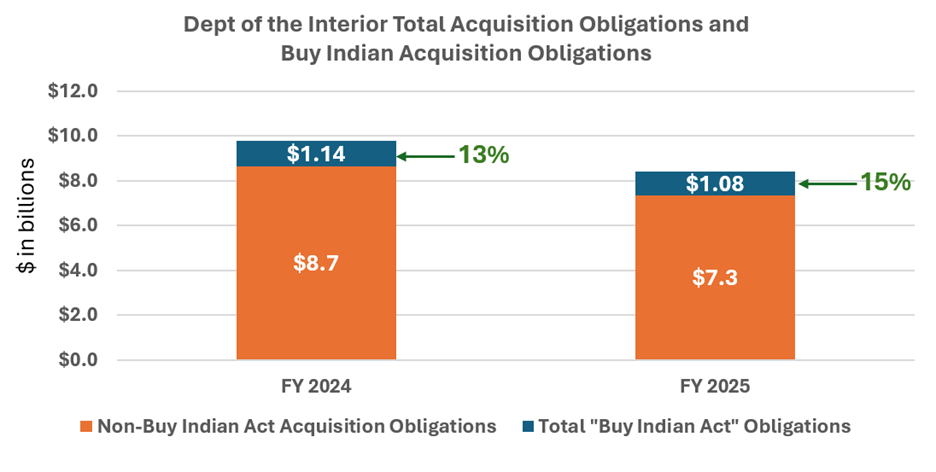
We’ll look at a couple of layers of data to see what kind of story we can tell. First, we’ll look at acquisition obligations across Interior.
Interior acquisition obligations as a whole dropped by $1.4 billion, while Buy Indian Act obligations declined by $60 million. As stated above, there are many reasons for acquisitions to drop, including new approval review processes, a very late appropriation, and staffing reductions.
While overall obligations decreased, the percentage of total Buy Indian Act obligations compared to total obligations increased in FY 2025. This may be a good sign that the smart acquisition vehicles created by Indian Affairs remain a strong option for managers across the Interior to support effective operations. Additionally, the tools and education provided by Indian Affairs to vendors such as the Buy Indian System for Award Management continue to help Indian Economic Enterprises identify procurement opportunities.
Graph based on Indian Affairs data from the Buy Indian Act Information and Tools webpage.
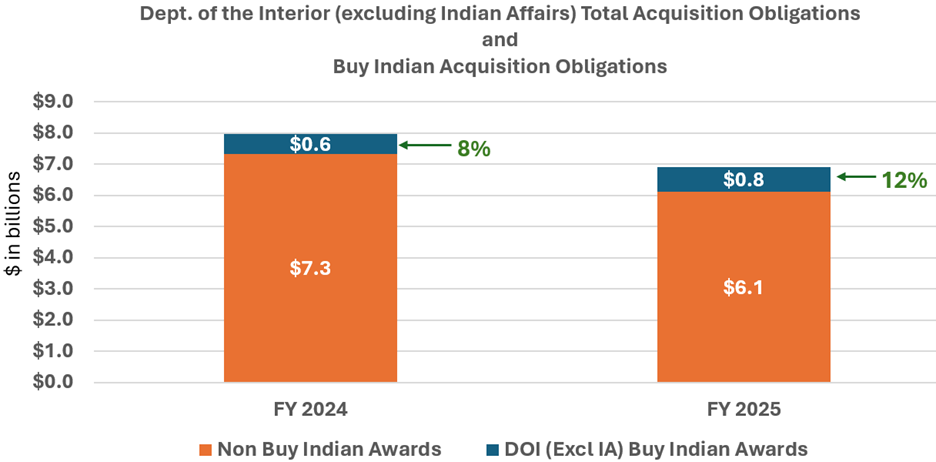
It helps if we dive a bit deeper into the data and focus on acquisition obligations for Interior bureaus outside of Indian Affairs. Interestingly, other Interior bureaus actually increased their Buy Indian Act obligations in FY 2025 by over $170 million, despite an overall reduction in total obligations. Difficult to pinpoint why, if I had to guess, it's likely some bureaus used Indian Affairs smart acquisition vehicles for construction purposes – one or two projects in this area can result in a big change in obligations. But it could be due to other factors. These acquisition vehicles have been well received by other Interior organizations and can also be used by the Indian Health Service.
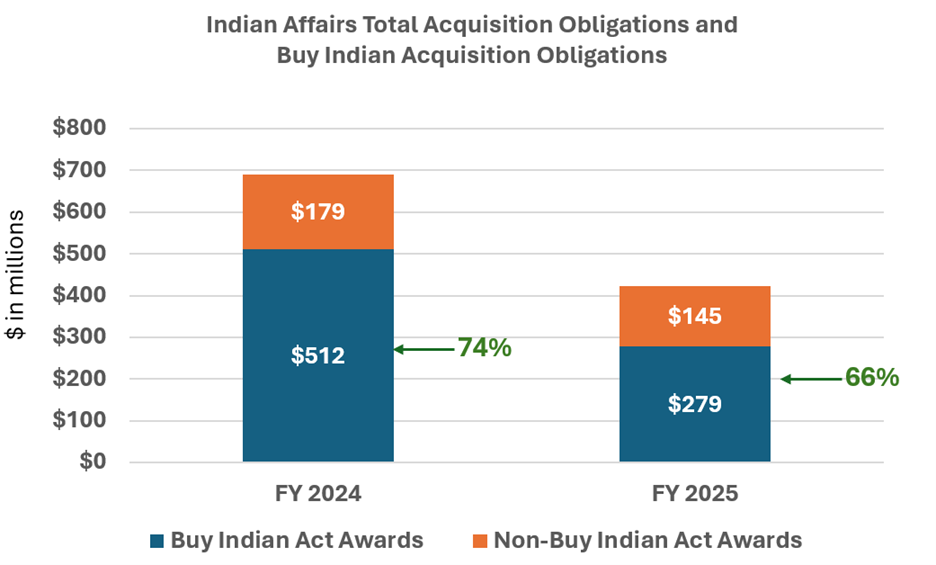
Last, we take a look at acquisition obligations within Indian Affairs. Total acquisition obligations dropped in FY 2025 by $268 million, and Buy Indian Act obligations dropped by $233 million. The percent of total obligations supporting Buy Indian Act awards dropped from 74% in FY 2025 to 66% percent in FY 2025.
Why the change?
I’d turn to the usual suspects of additional approval processes, fewer staff, and late appropriations as major factors. Like other parts of DOI, construction is often a big swing factor in Indian Affairs acquisition obligations. One construction project not making it through the acquisition process before year's end can easily result in a $100 million or more swing in total obligations.
The expiration of the Great American Outdoors Act Legacy Restoration Fund, which provides $95 million a year for BIE School Construction, could also contribute to the lower levels. The LRF expired at the end of FY 2025, so no additional funds would have been available in FY 2026. LRF funds are often critical to ensuring sufficient resources on hand to advertise a procurement opportunity for BIE construction projects. Fingers crossed, the LRF is reauthorized later this year to support the continued modernization of BIE schools and address the maintenance backlog.
Moving forward
It will be important to continue tracking trends in Buy Indian Act data, as well as any changes in policy. The regulations and policies in place, as well as the strong use of smart acquisition vehicles and educational outreach efforts, have enabled Indian Affairs to make the implementation of the Buy Indian Act an economic win for Indian Country and to help leaders at other Interior bureaus and the IHS advance more effective operations.
